
/ 5.0
HVRL Lab Evaluation Score
•
Evaluated by Julian Vance
The Mill Food Recycler makes everyday food waste easier to manage by drying and grinding kitchen scraps into a smaller volume of reusable Food Grounds. However, it costs nearly $1,000, requires Wi-Fi during initial setup, and does not produce finished compost. I consider the Mill Plus the better-equipped model, while the Mill Essential makes more sense for households that want the same 6.5-liter processing capacity without paying extra for a foot pedal and additional features.
The biggest question isn’t whether Mill can shrink food scraps. It can. What matters is whether the convenience, odor filtration, and reduced trash volume justify the purchase price and ongoing maintenance.
Mill Food Recycler Quick Verdict
The Mill Food Recycler is best for households that generate food scraps daily, want to reduce kitchen trash, and don’t want to maintain a traditional countertop compost container. Its biggest strengths are its large removable bucket, automatic drying and grinding, and ability to process a broad range of food scraps, including meat, dairy, and small bones.
However, I wouldn’t recommend buying it simply because you want an automatic composting machine. Mill does not produce finished compost, and you still need a practical way to reuse, dispose of, or ship the resulting Food Grounds.
Mill Food Recycler Pros and Cons
| Pros | Cons |
|---|
My verdict: Mill Essential is the better value for most buyers because it provides the same processing capacity for $150 less. Mill Plus is worth considering if hands-free lid operation, integrated weight measurement, and longer filter life matter to you. Neither model is a good purchase if you expect finished compost straight out of the bucket.
Mill Plus vs. Mill Essential: Specifications Compared
The two Mill Food Recycler versions share the same basic food-processing system. Their differences are primarily physical size, weight, lid operation, filtration intervals, and measurement features.
| Specifications | Mill Plus | Mill Essential |
|---|
Specifications are based on Mill’s product comparison and manufacturer support information.
Size and Placement: Measure Your Kitchen First
Mill Plus stands 27 inches tall, compared with 23 inches for Mill Essential. Both are 17 inches wide and 14 inches deep.
That four-inch height difference matters more than it initially appears. The Plus needs approximately 37 inches of vertical clearance for its lid, while Essential requires approximately 33.5 inches.
I would measure the entire opening area rather than relying on the appliance’s closed height. A machine that fits beneath a counter isn’t necessarily convenient if its lid cannot open fully.
The Plus weighs 56 pounds, while Essential weighs 45 pounds. Both figures include the empty internal bucket.
Neither is a particularly lightweight appliance to reposition frequently. The removable bucket also weighs approximately 12 pounds before adding any processed food grounds.
If I were choosing a permanent location, I’d prioritize three things:
- A nearby grounded electrical outlet.
- Enough overhead clearance to open the lid comfortably.
- An accessible position that allows me to remove the bucket without twisting or lifting awkwardly.
Lid Design: Where Mill Plus Justifies Its Higher Price
The biggest everyday difference is how the two lids open.
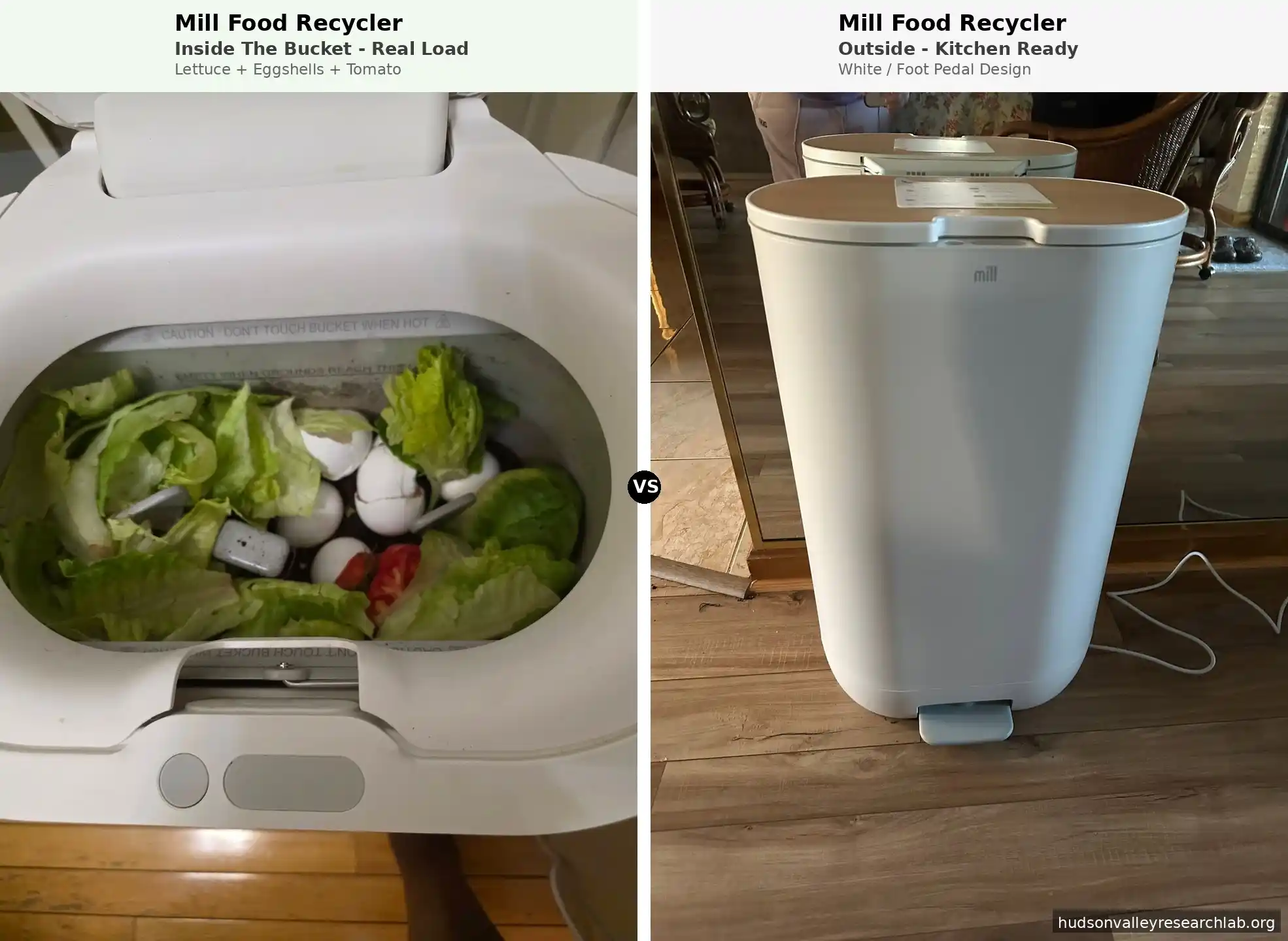
Mill Plus uses a foot pedal, allowing me to open the lid without putting down a plate, cutting board, or handful of food scraps. This is a small convenience, but it makes sense in a busy kitchen where both hands are often occupied.
Mill Essential uses a manually operated lid that stays open once lifted. It doesn’t offer the same hands-free operation, but it still provides access without requiring you to hold the lid continuously.
I wouldn’t pay an extra $150 for the foot pedal alone unless I expected to use the machine frequently. For occasional food-waste processing, Essential’s simpler lid is perfectly reasonable.
One additional distinction is the integrated weight sensor on Mill Plus. It measures added food waste, whereas Essential estimates its impact using the machine’s software.
How the Mill Food Recycler Actually Works
Mill is a food dehydrator and grinder designed specifically for household food scraps. It uses heat and stainless steel rotating augers to dry and break down discarded food into smaller, lighter Food Grounds.
The process reduces food-waste volume by up to 80%, making the contents considerably easier to store and handle than wet kitchen scraps.
The internal bucket holds 6.5 liters, or approximately 1.7 gallons, and can accommodate up to 10 pounds of newly added wet food scraps per processing cycle.
Drying and Grinding Instead of Traditional Composting
This distinction is important.
Traditional composting relies on microorganisms breaking down organic material over time. Mill uses a mechanical and thermal process to remove moisture and grind the material.
The resulting Food Grounds are not finished compost. They are dehydrated and ground food scraps that still need further biological decomposition before becoming stable compost.
I would not treat the output as ready-to-use potting soil or assume that it can be scattered across a garden without preparation.
How Often Do You Need to Empty It?
Mill is designed to accommodate daily additions of food scraps while processing and compacting the material over time.
The company describes approximately four weeks of capacity under typical household use, although the actual interval depends on how much food waste you generate and how wet it is.
This is one of the product’s strongest practical advantages.
Instead of carrying a container of wet vegetable peels, coffee grounds, meat scraps, and leftovers outside every day, you can add suitable food waste as needed.
The important distinction is that the 10-pound figure refers to newly added wet scraps per cycle, not the amount of finished Food Grounds the bucket can hold at one time.
What Can and Cannot Go Into the Mill Food Recycler?
Mill accepts a wider range of kitchen waste than many traditional home composting arrangements. However, it isn’t designed to process every organic material.
Knowing the restrictions helps prevent jams, unpleasant residue, and unnecessary maintenance.
Food Waste You Can Add
The following categories are suitable for the Mill Food Recycler:
- Fruits and vegetables: Fruit peels, vegetable scraps, apple cores, pear cores, seeds, and similar kitchen leftovers.
- Meat and poultry: Meat scraps, animal fat, fish, poultry, and suitable leftover cooked meat.
- Small bones: Small chicken bones and fish bones.
- Dairy and leftovers: Rice, pasta, bread, cheese, condensed milk, and ordinary leftover food.
- Coffee and tea: Coffee grounds and biodegradable paper tea bags.
- Pet food: Suitable leftover pet food.
This flexibility is particularly useful if your kitchen regularly produces a mixture of vegetable scraps, cooked leftovers, meat, and dairy.
Food Waste You Should Never Add
Some materials can damage the processing system or create problems inside the bucket.
Avoid adding:
- Large bones: Beef, pork, and lamb leg bones or other large, hard bones.
- Hard seafood shells: Oyster shells, scallop shells, and large crab shells.
- Large quantities of liquid: Soup, broth, and substantial amounts of leftover cooking oil or grease.
- Compostable plastics: Compostable bags, plastic packaging, and other packaging materials.
- Yard waste: Grass clippings, fallen leaves, garden trimmings, and outdoor cleanup debris.
- Concentrated sugar: Large quantities of honey, syrup, and similarly sticky substances that can create residue.
The Mill is intended for kitchen food scraps, not general organic waste. You cannot use it as a replacement for a yard-waste bin.
Everyday Handling, Loading, and Cleaning
The most important part of evaluating a food recycler is understanding what happens between meals. Loading scraps is straightforward, but the way you handle wet, fatty, and fibrous materials affects how convenient the machine remains.
Loading Wet and Sticky Food Scraps
Fruit peels, vegetable trimmings, and ordinary leftovers are relatively straightforward to add.
However, greasy meat scraps and fatty leftovers deserve more attention. When these materials collect at the bottom of the bucket, they can leave a sticky residue that is less pleasant to clean.
My practical recommendation is to avoid dumping a large amount of concentrated grease or fatty residue into one batch.
For particularly greasy scraps, keeping them frozen until you can combine a small amount with a more absorbent batch may help reduce handling problems. This is a practical precaution, not a manufacturer-approved substitute for the food-loading instructions.
Handling Long, Fibrous Vegetables
Long fibers are another potential problem.
Celery stalks, corn husks, jackfruit fibers, and pineapple fibers can wrap around rotating components if added in large, tangled pieces.
I would cut these materials into shorter sections of approximately 1–1.2 inches (2–3 cm) before adding them.
This simple preparation reduces the chance of long strands becoming tightly wound around the augers.
If the machine reports an obstruction or overload, don’t keep trying to force it through another cycle. Follow Mill’s troubleshooting and cleaning instructions before attempting to restart it.
Removing and Cleaning the Bucket
The internal bucket is made from die-cast aluminum with a ceramic coating. It has a capacity of 6.5 liters and weighs approximately 12 pounds when empty.
Removing it is not the same as lifting a lightweight kitchen compost pail. Once filled with Food Grounds, the total weight increases, so I would use both hands and avoid rushing the process.
The ceramic coating helps prevent food from sticking excessively, but it doesn’t eliminate the need for cleaning.
I would pay particular attention to:
- Greasy residue around the bottom of the bucket.
- Sticky food deposits along the inner walls.
- Food particles around the rim.
- Residue that accumulates after processing fatty or sugary scraps.
Avoid abrasive cleaning tools or harsh chemicals that could damage the bucket’s coating. Follow Mill’s instructions for washing and drying the removable components.
Odor Control and Operating Noise
Odor control is one of the most important reasons to consider the Mill Food Recycler.
Wet food scraps can develop unpleasant smells when they sit in an ordinary kitchen container, especially when the contents include meat, fish, dairy, onions, and other strongly scented ingredients.
Mill uses an activated carbon filter made from upcycled coconut shells to reduce odors escaping from the appliance.
The manufacturer advertises odor filtration that blocks up to 99.9% of odors. This is a filtration claim, not a guarantee that absolutely no smell will ever be detectable.
Does the Mill Produce Any Smell?
In normal use, the filtration system is designed to keep unpleasant food-waste odors contained.
However, I wouldn’t interpret odor filtration as complete odor elimination under every possible condition.
Strongly seasoned leftovers, onions, garlic, roasted foods, and fatty scraps can produce a warm cooked-food smell during the heating cycle.
This distinction matters if you plan to run the machine overnight in a small kitchen connected directly to your living room.
The carbon filter also needs periodic replacement. Mill Plus is rated for up to 10–12 months of filter life, while Mill Essential is rated for up to 5–6 months. Actual replacement intervals depend on usage and the types of food being processed.
How Loud Is the Mill Food Recycler?
Mill advertises quiet operation, with published product information describing the appliance at approximately 44 dB.
However, independent testing has produced different results.
In a six-week WIRED review, the reviewer measured approximately 57–60 dB during operation, noticeably higher than the advertised figure.
This difference is worth considering if you intend to run the machine close to a bedroom, home office, or television area.
I would avoid assuming that the Mill is completely silent simply because it is designed for indoor kitchen use.
A practical approach is to schedule processing for a time when the operating noise is less likely to interfere with your household routine.
Wi-Fi, Mobile App, and Smart Features
Mill is a connected kitchen appliance, not simply a plug-in food grinder.
Both versions require a 2.4GHz Wi-Fi connection for initial setup, along with a compatible smartphone and the Mill mobile app.
The machine uses Bluetooth and internet connectivity during pairing and setup to activate its internal clock and automated scheduling functions.
This is an important ownership consideration.
If you don’t want another connected appliance in your kitchen, Mill may feel unnecessarily complicated.
What Does the App Do?
The Mill app provides several useful functions:
- Initial device setup and account activation.
- Automatic processing schedules.
- Manual cycle controls.
- Food-scrap guidance.
- Food-waste tracking.
- Impact estimates and usage information.
The app also helps identify which foods are suitable for processing.
Mill Plus has an integrated weight sensor for measuring added food waste. Essential uses a software-based estimate instead.
Can You Use Mill Without Wi-Fi?
There is an important distinction between initial setup and everyday operation.
According to Mill Support, you need a smartphone and an internet connection during initial pairing and setup.
After setup, you can start manual processing cycles using the lid button without maintaining a Wi-Fi connection.
However, automatic scheduling, impact reporting, and some troubleshooting functions may be unavailable without consistent connectivity.
I would therefore consider Wi-Fi essential for getting the full smart experience, even though manual operation remains possible after setup.
Safety Features and Operating Conditions
Mill is designed for indoor residential use.
Both models require:
- 120 VAC electrical supply.
- 60Hz frequency.
- 4.5A electrical rating.
- A three-prong power connection.
- An 8.2-foot (2.5-meter) power cord.
- 2.4GHz Wi-Fi for connected features.
The intended operating temperature is 61°F–86°F (16°C–30°C).
The appliance is TUV-certified to UL499, according to Mill’s technical specifications.
Mill also incorporates child- and pet-safety features designed to stop operation when the lid is opened during a processing cycle. Check the specific model’s safety instructions and lid-lock behavior rather than assuming every feature works identically across both versions.
I would keep the machine away from outdoor exposure, standing water, and locations where the electrical cord could become a tripping hazard.
An Important Note for International Buyers
The standard Mill Food Recycler is designed for the US electrical supply: 120V, 60Hz.
If you live outside the United States, don’t assume that a simple plug adapter makes it compatible with a 220–240V household supply.
Check the electrical rating and manufacturer guidance before connecting it. This is particularly important for buyers in countries such as Vietnam, where standard household voltage differs from the US specification.
Food Grounds: What Happens After the Processing Cycle?
This is arguably the most important section of the entire review.
Mill reduces food waste, but it doesn’t make that waste disappear. You still need to decide what to do with the resulting Food Grounds.
The output is dry, ground food material. It contains organic matter, but it hasn’t undergone the microbial decomposition required to become mature compost.
Why You Shouldn’t Spread Food Grounds Directly on Wet Soil
Food Grounds can absorb moisture again after being exposed to rain or damp soil.
If you spread a thick layer directly across the garden surface, the material can become wet, develop mold, and attract unwanted animals or insects.
This is an important limitation to understand. Dried food waste is not automatically ready-to-use fertilizer.
How to Reuse Food Grounds More Responsibly
There are several practical options.
Option 1: Add Food Grounds to an Existing Compost Pile
This is one of the most straightforward approaches if you already maintain a composting system.
Mix the grounds with other compost materials and allow microorganisms to break them down over time.
A well-managed compost pile provides a more suitable environment than leaving a thick layer of dried food scraps exposed on the ground.
Option 2: Mix with Soil and Bury Properly
If you intend to use the grounds in garden soil, follow Mill’s current application guidance rather than treating them like ordinary finished compost.
Use a conservative soil-to-grounds ratio, mix thoroughly, and bury the material rather than leaving it exposed on the surface.
The amount of soil required depends on the application and the manufacturer’s current instructions. I would not treat a universal 1:4 ratio or a fixed burial depth as a guaranteed recipe for every type of soil.
Option 3: Use the Mill Pickup Service
Mill offers a food-grounds collection program in eligible areas of the United States.
The service provides shipping materials and prepaid USPS labels so customers can return their processed Food Grounds.
The company works with farm partners to turn the returned material into food for chickens.
This is particularly useful if you don’t have a garden, compost pile, or other practical way to reuse the output.
However, service availability, subscription fees, and shipping eligibility depend on location and current program terms.
Mill Food Recycler Price and Total Cost of Ownership
The initial purchase price is only part of the financial commitment. Replacement carbon filters and the optional Mill Pickup Service can add a noticeable amount to the cost of owning the machine.
For me, this is an important consideration because a $1,000 kitchen appliance should be evaluated over several years, not just by its checkout price.
Initial Purchase Price
- Mill Essential: $999.
- Mill Plus White: Starting at $1,149.
- Mill Plus Stainless Steel or Matte Black: Additional cost depending on finish; certain configurations can reach approximately $1,200.
Both models include an initial carbon filter. Mill Essential’s included filter is valued at $59 and typically lasts up to 5–6 months.
Check the manufacturer’s current checkout price because promotions and available finishes can change.
Carbon Filter Replacement Costs
The two models have different filter prices and replacement intervals.
| Filter costs | Mill Essential | Mill Plus |
|---|
These annual figures are planning estimates based on the manufacturer’s typical replacement intervals, not guaranteed yearly bills. Actual replacement timing depends on use and filter condition.
Mill Essential has a lower individual replacement price, but its shorter filter life means you may need to purchase replacements approximately twice as often.
Mill Plus costs more per filter, but one replacement can last approximately a year under typical use.
Mill Pickup Service: An Optional $192 Annual Expense
Not everyone wants to use Food Grounds in a garden or maintain a traditional compost pile.
Mill offers an optional Pickup Service for households that want to send the processed material back to the company.
The current annual plan costs $192 plus applicable tax, equivalent to $16 per month when billed annually.
The service includes:
- Prepaid, food-safe return boxes.
- Bag liners for storing Food Grounds.
- On-demand USPS front-door pickups where the address is eligible.
- Personalized impact reports.
- Collection and routing of the material to a farm partner for reuse as chicken feed.
Mill says the average household empties its bin every 4–6 weeks, although actual frequency depends on food-waste volume.
This service is not included in the $999 Essential or $1,149 Plus purchase price. You must opt in separately, and availability depends on your location.
For households without a garden or composting setup, the pickup subscription can make Mill substantially more practical. However, it also adds a recurring expense.
Estimated First-Year and Ongoing Ownership Costs
The following estimates assume that you purchase the machine outright, use the standard white versions, and replace filters according to typical manufacturer intervals.
| Ownership expense | Mill Essential | Mill Plus |
|---|
To make the financial comparison easier, here are two illustrative ownership scenarios.
Scenario A: Using Mill without the Pickup Service
- Essential: Approximately $1,117–$1,140 in the first 12 months if two replacement filters are needed after the included filter.
- Plus: Approximately $1,263 in the first 12 months if one replacement filter is needed after the included filter.
These estimates include the purchase price and assumed replacement filters, but exclude electricity, taxes, and other costs.
Scenario B: Using Mill with the Pickup Service
- Essential: Approximately $1,309–$1,332 in the first 12 months.
- Plus: Approximately $1,455 in the first 12 months.
These estimates add the $192 annual pickup subscription before tax.
Actual first-year filter spending can be lower if the included filter lasts through the end of the first year. The replacement schedule depends on the date of first use and how heavily the machine is operated.
Which Model Is Cheaper to Maintain?
The difference isn’t as straightforward as the purchase price suggests.
Mill Essential costs $150 less initially, but its filters need replacing more frequently. Mill Plus costs more upfront but has a longer filter interval.
If I were comparing long-term ownership costs, I would consider the following:
- Choose Essential if keeping the upfront purchase price low matters most.
- Choose Plus if you prefer fewer filter replacements and the added convenience of its foot pedal.
- Skip Pickup if you already have a practical way to use or compost Food Grounds.
- Consider Pickup if you otherwise have no convenient disposal option and are comfortable paying $192 annually.
My conclusion on TCO: The Mill is not a one-time $999 purchase if you plan to use its odor filtration and collection services over several years. Filters are a recurring maintenance expense, and the optional pickup subscription adds another $192 plus tax each year. These costs should be part of the buying decision from the beginning.
Common Mill Food Recycler Problems and Practical Solutions
The Mill is convenient, but it isn’t maintenance-free. A few operating limitations are worth understanding before spending nearly $1,000.
Problem 1: Food Grounds Become Moldy After Rehydration
Why it happens: The machine removes moisture, but it doesn’t complete the biological composting process. When Food Grounds absorb water again, they can support mold growth.
What I would do: Avoid leaving the material exposed on damp soil. Mix it into an established compost pile or follow Mill’s recommended soil application procedure.
Problem 2: Long Fibers Can Wrap Around the Augers
Why it happens: Long, stringy materials can become entangled in rotating components, particularly when large quantities are added together.
What I would do: Cut celery, corn husks, pineapple fibers, and similar scraps into short pieces before loading. Avoid feeding a large tangled bundle into the bucket.
Problem 3: Strong Food Smells During Heating
Why it happens: Activated carbon filtration reduces escaping odors, but strongly scented foods can still produce a noticeable warm-food smell during processing.
What I would do: Keep the filter properly installed, replace it according to the manufacturer’s schedule, and schedule processing when the smell or noise is less likely to bother anyone.
Problem 4: Greasy Scraps Leave Residue
Why it happens: Large quantities of fatty food can leave sticky deposits on the bucket’s interior.
What I would do: Avoid adding concentrated grease or large amounts of oily liquid. Clean the bucket according to the manufacturer’s maintenance instructions.
Problem 5: Initial Setup Requires a Smartphone and Wi-Fi
Why it happens: Mill needs its app and an internet connection during initial pairing and setup.
What I would do: Check smartphone compatibility and 2.4GHz network availability before purchasing. If you prefer appliances that work entirely offline from day one, this requirement may be a deal-breaker.
Mill Plus vs Mill Essential: Which Model Makes More Sense?
I wouldn’t choose between these models based on processing capacity because both use the same 6.5-liter bucket and accept up to 10 pounds of new wet food scraps per cycle.
The decision comes down to convenience and ownership costs.
Choose Mill Plus If:
- You frequently add food scraps throughout the day.
- You want a foot pedal instead of manually lifting the lid.
- You prefer the integrated weight sensor.
- You want the longer advertised carbon-filter life.
- You like the stainless steel or matte black finish.
- You are comfortable paying more for everyday convenience.
Choose Mill Essential If:
- You want the same basic food-processing capacity for less money.
- You don’t mind opening the lid manually.
- You prefer a shorter appliance.
- You only need the standard white finish.
- You don’t require the integrated weight sensor.
- You want to minimize the initial purchase price.
For most households comparing the two, I think Essential is the more sensible financial decision. It performs the same fundamental food-recycling task without requiring an additional $150 for features that may not matter to everyone.
However, Plus becomes more appealing when the machine is used repeatedly throughout the day and hands-free access is genuinely valuable.
Is the Mill Food Recycler Worth Buying?
The Mill Food Recycler makes sense if your biggest problem is managing wet kitchen food waste rather than producing finished compost.
Its 6.5-liter bucket, automatic drying and grinding, broad food compatibility, and carbon filtration make it a convenient alternative to keeping scraps in a traditional countertop container.
I particularly like the concept of being able to add suitable leftovers throughout the day without constantly worrying about a container of wet food scraps sitting in the kitchen.
But there are three limitations I wouldn’t overlook.
First, the machine is expensive. At $999 for Essential and $1,149 for Plus, it is a substantial investment for an appliance that doesn’t replace every part of the composting process.
Second, Food Grounds still require proper handling. If you don’t have a garden, compost pile, eligible municipal collection service, or access to Mill’s pickup program, you need to think carefully about what happens after the bucket fills.
Third, the machine depends on an app and initial Wi-Fi setup. This may be perfectly acceptable for connected-home users, but it adds complexity that a conventional compost container simply doesn’t have.
My Final Recommendation
I’d choose the Mill Essential for most households that want to reduce kitchen food waste without paying extra for a foot pedal and integrated weight measurement.
I’d choose the Mill Plus if I expected to open the machine repeatedly throughout the day and valued hands-free operation, the longer filter interval, and the additional design options.
Neither model is a replacement for traditional composting. Instead, Mill is best understood as a food-waste reduction appliance that makes handling kitchen scraps cleaner and more convenient.
If you’re comfortable with its price, electrical requirements, maintenance costs, and Food Grounds disposal process, the Mill can be a useful addition to a busy kitchen. If you simply want inexpensive composting, a traditional compost bin is still the more economical choice.
Frequently Asked Questions
What is the difference between Mill Plus and Mill Essential?
Mill Plus has a foot pedal, an integrated weight sensor, a 27-inch height, and a carbon filter rated for up to 10–12 months. Mill Essential has a manual stay-open lid, software-estimated impact tracking, a 23-inch height, and a carbon filter rated for up to 5–6 months. Both have the same 6.5-liter processing capacity.
Does the Mill Food Recycler make real compost?
No. Mill produces dried and ground Food Grounds, not finished compost. The material still needs microbial decomposition before becoming mature compost.
Can I put meat and bones in the Mill?
Yes. The machine accepts suitable meat, fish, poultry, and small bones such as chicken and fish bones. Large beef, pork, and lamb bones should not be added.
How often do I need to empty the Mill?
Mill is designed for approximately four weeks of household food-waste capacity, although the actual interval depends on how much waste you generate and its moisture content.
Does the Mill Food Recycler smell?
Its activated carbon filtration system is designed to block up to 99.9% of odors. However, strongly scented foods can still produce a warm cooked-food smell during processing, and the filter requires periodic replacement.
Does the Mill require Wi-Fi?
Yes, a compatible smartphone, the Mill app, and internet connectivity are required for initial setup. After pairing, you can start manual processing cycles without Wi-Fi, but some smart features will be unavailable.
How much electricity does the Mill use?
Consumption varies with the amount and moisture content of the food being processed and the frequency of operation. A reliable daily cost estimate requires measurements under consistent operating conditions.
Can I put Mill Food Grounds directly into my garden?
You should not treat them as finished compost or spread a thick layer on wet soil. They can rehydrate, develop mold, and attract pests. Use an established composting process or follow Mill’s current soil application instructions.
How much does the Mill Food Recycler cost?
The listed starting prices are $999 for Mill Essential and $1,149 for Mill Plus. Finish options, promotions, and additional services can change the final cost.
How much does it cost to maintain a Mill Food Recycler?
Mill Essential replacement filters cost $59 each and typically last 5–6 months. Mill Plus filters cost $114 each and typically last 10–12 months. The optional Mill Pickup Service costs $192 plus tax annually.
Is Mill Pickup worth the $192 annual fee?
It can be worthwhile if you don’t have a garden, compost pile, or other convenient way to reuse Food Grounds. The subscription includes return boxes, liners, and prepaid USPS pickup where available. If you already compost at home, you may not need this service.
Is Mill Plus worth the extra $150?
It can be worth the difference if you value the foot pedal, integrated weight sensor, longer filter life, and additional finish options. If you mainly care about processing capacity, Essential offers the same 6.5-liter bucket for less money.