
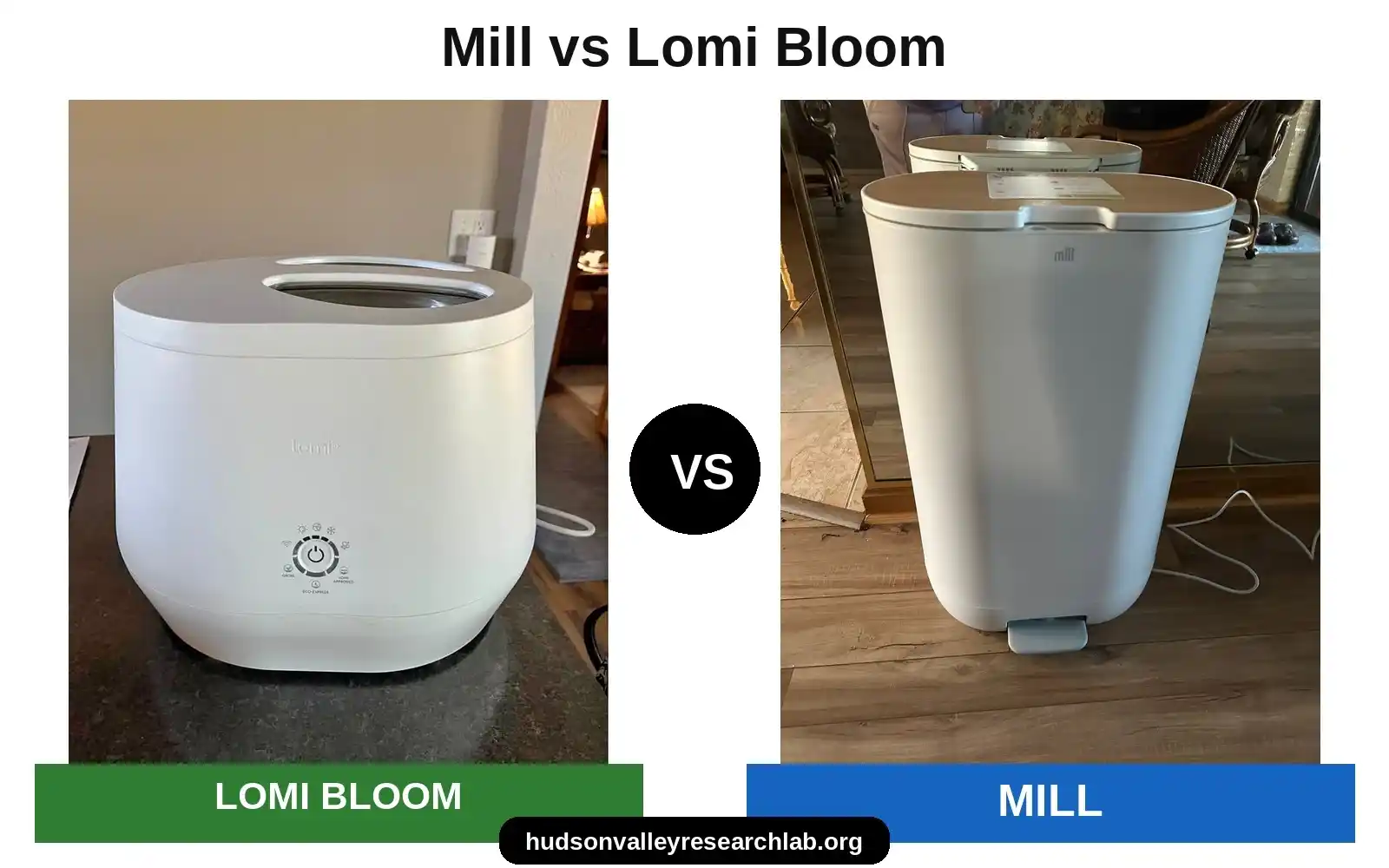
If you want to reduce the amount of food waste going into your trash, both the Mill and Lomi Bloom can help. But they are designed for very different kitchens. Mill is the better choice for households that produce a lot of food scraps and want a large, low-maintenance system. Lomi Bloom is more affordable, takes up less space, and suits people who process smaller batches on a countertop.
The biggest differences are capacity, convenience, ongoing costs, and what you can realistically do with the processed material. Neither machine should be treated as a shortcut to fully finished compost.
Quick Verdict: Mill or Lomi Bloom?
- Choose Mill if you cook frequently, generate a lot of food scraps, and want to load the machine throughout the day without running a cycle after every batch.
- Choose Lomi Bloom if you have limited floor space, produce less food waste, and prefer a smaller machine with a lower upfront price.
- Choose neither if you expect to put the output directly into your garden as finished compost without further decomposition.
Key Test Findings
- Testing environment: Home kitchen, with Lomi Bloom placed on a granite countertop.
- Noise measurement: Approximately 3 feet from the machine while grinding dense root scraps and carrot tops.
- Recorded noise: 57–60 dB during the observed grinding test.
- Odor observations: Orange peels and coffee grounds produced a more pleasant smell, while broccoli and other strong-smelling scraps left a noticeable cooked-food odor.
- Everyday handling: Mill’s loaded bucket can become cumbersome to lift after several weeks of use, while Lomi Bloom’s smaller removable bucket is easier to handle.
| Feature | Mill | Lomi Bloom |
|---|
Capacity: Mill Handles Much More Food Waste
Capacity is the first major difference between these machines.
Mill has a 6.5-liter bucket, equivalent to roughly 1.7 gallons. It can accept up to 10 pounds of fresh food waste in a cycle, and you can keep adding scraps throughout the day. Instead of processing every time you peel vegetables or clear dinner plates, you load the machine and let its automatic schedule handle the work.
For a household that cooks regularly, this makes a noticeable difference. You do not have to stop and decide whether a small amount of scraps is worth running a cycle.
Lomi Bloom is much smaller. Its bucket holds approximately 3 quarts in total, with about 2.5 liters recommended for usable capacity. That is enough for everyday kitchen scraps from a smaller household, but it fills much faster when you cook frequently.
The practical difference is how often you need to deal with the machine. Mill is designed for continuous daily loading, while Lomi Bloom works better when you are comfortable processing smaller batches.
My take: Mill is the more practical option for a family that produces a steady stream of food scraps. Lomi Bloom makes more sense if you have limited counter space and do not generate much waste.
Emptying the Bucket: A Bigger Job With Mill
Mill’s larger capacity is useful, but it also creates a heavier bucket when it is time to empty it.
The empty bucket weighs about 12 pounds. After several weeks of loading and processing food scraps, the accumulated Food Grounds can push the total weight above 20 pounds. If you leave it for around three weeks, lifting the loaded bucket with one hand and carrying it to an outdoor trash bin can become awkward.
This is one of the trade-offs of choosing a high-capacity machine. You empty it less often, but the job can be more physically demanding when you finally do.
Lomi Bloom’s smaller removable bucket is easier to lift and handle. You can take it out, empty the processed material, and put it back without dealing with the same volume and weight as Mill.
However, the smaller bucket also means more frequent emptying if you produce a lot of scraps.
My take: Mill reduces how often you empty the machine, but Lomi Bloom is easier to handle when emptying day arrives. If lifting a heavy container is a concern, do not overlook this difference.
Processing Time, Electricity, and Noise
Mill and Lomi Bloom use different processing schedules.
Mill automatically dries and grinds food scraps, typically running overnight or according to its scheduled operation. You do not need to start a separate cycle every time you add food waste.
Lomi Bloom gives you more control through its different modes:
- Eco-Express: Approximately 3–5 hours, using around 0.6–0.64 kWh.
- Lomi Approved: Approximately 5–8 hours, using around 0.6–0.7 kWh.
- Grow: Approximately 16–20 hours, using around 0.93–1.0 kWh. Smart Cycle operation may take approximately 12–14 hours.
Actual energy use depends on the selected mode, food mixture, moisture level, and operating conditions. The longer Grow mode uses more electricity than the shorter cycles.
What about operating noise?
Mill lists a manufacturer noise rating of 44 dB. Lomi Bloom is rated below 60 dB. Those figures are useful for reference, but they do not necessarily describe what you will hear in a kitchen during every cycle.
In our kitchen test on a granite countertop, placing a decibel meter roughly three feet away while grinding dense root scraps and carrot tops registered between 57 and 60 dB. It isn’t loud enough to disrupt conversation, but it sounds like a steady, low-humming dishwasher rather than a silent appliance.
The type of food being processed and the surface supporting the machine can affect the sound you hear. Dense scraps can create a different noise profile from softer food waste.
Electrical considerations
Both appliances are designed for standard U.S. household power. Mill is rated at 120V, 60Hz, and 4.5A. Lomi Bloom has a maximum power rating of 500W.
Avoid running either appliance on a heavily loaded branch circuit shared with high-power kitchen equipment such as an air fryer, microwave, or rice cooker. Plugging two appliances into separate outlets does not necessarily mean they are on separate circuits. If you are unsure about your kitchen circuit capacity, consult a qualified electrician.
What Comes Out: Food Grounds Are Not Finished Compost
One important point is easy to misunderstand: neither Mill nor Lomi Bloom instantly turns kitchen scraps into fully matured compost.
Mill calls its processed output Food Grounds, while Lomi calls its output Lomi Earth. Both machines reduce the volume of food waste by drying and grinding it, but the resulting material may still need further biological decomposition before it is ready to function like mature compost.
Think of the output as processed food waste rather than finished garden compost.
When the material is mixed with moisture and soil, microbial activity can continue. Depending on the ingredients and conditions, you may notice white mold or a sour smell as decomposition resumes. That does not automatically mean the machine has failed; it means the material is still biologically active.
For that reason, I would not treat a fresh batch as ready-to-use potting soil.
A gradual approach is safer. Mix a modest amount into an appropriate composting or soil system and allow it to break down further. A ratio such as one part Lomi Earth to ten parts soil or growing medium, followed by another two to three weeks of decomposition, can be used as a cautious starting point—not as a universal manufacturer-approved formula. The right amount and waiting time depend on the material and growing conditions.
My take: Buy either machine to reduce and manage food waste, not because you expect it to replace a complete composting process.
Odor Control: Carbon Filters Help, but They Do Not Remove Every Smell
Both machines use carbon filtration to reduce unpleasant odors, but neither should be considered completely odor-free.
Mill uses a coconut-shell carbon filter. The Essential filter is generally replaced every 5–6 months, while the Plus filter is designed for approximately 10–12 months of use.
Lomi Bloom uses two activated-carbon filters: a flat rear filter and an internal cylindrical filter. The recommended replacement interval is approximately three months or after 45 cycles.
The type of food you process makes a difference. Orange peels and coffee grounds can produce a pleasant smell as they warm and dry. Broccoli and other sulfur-rich scraps are less pleasant. When those scraps are processed overnight, the carbon filter may still let through a strong overcooked-food smell.
This is particularly noticeable with foods that have a strong smell before they go into the machine. Carbon filtration can reduce odors, but it cannot guarantee that every batch will smell neutral.
I would also be careful with seafood scraps. Before adding shrimp shells or other seafood waste, check the accepted-food guidance for your exact model rather than assuming every type of kitchen waste is suitable.
My take: Both machines manage everyday odors, but neither eliminates them completely. If you frequently process strong-smelling foods, expect some odor during operation.
Cleaning and Routine Maintenance
Neither machine is maintenance-free. Food residue, moisture, and fine particles can build up over time, especially if you regularly process sticky or sugary scraps.
With Mill, the removable bucket makes it easier to handle the processed material. You still need to keep the bucket and surrounding areas clean and follow the manufacturer’s maintenance instructions.
Lomi Bloom’s smaller bucket is easier to remove and handle, but its compact design means you should pay attention to residue around the bucket and interior surfaces.
Sticky foods deserve extra attention. Sweet fruit, watermelon, mango, and sticky rice can leave caramelized or tacky residue after heating. If you process these foods, check the machine after the cycle rather than allowing residue to accumulate.
For routine cleaning:
- Let the machine cool and follow the manufacturer’s instructions before cleaning.
- Remove the bucket and empty it carefully.
- Use a soft cloth to wipe accessible surfaces.
- Avoid abrasive tools that could damage the interior.
- Do not use unapproved cleaning mixtures or pour water into areas that are not designed to get wet.
- Clean residue before it hardens and becomes more difficult to remove.
Filter replacement is another part of ownership. Mill’s filter schedule depends on whether you own the Essential or Plus model. Lomi Bloom’s two filters generally need replacement about every three months or after 45 cycles.
Difficult Food Scraps and Potential Jams
Not all food waste behaves the same way inside a drying and grinding machine.
Soft vegetable scraps and ordinary leftovers are generally easier to process than long, fibrous, or unusually hard materials.
Fibrous foods can cause problems if you add them in long or tangled pieces. Common kitchen scraps such as corn husks, artichoke leaves, asparagus ends, and celery ribs deserve extra attention. Cut suitable scraps into smaller pieces—roughly 1 inch (about 2–3 cm)—to make them easier to process, but only add ingredients approved for your specific machine.
Large bones, fruit pits, and other hard materials should not go into either machine unless the manufacturer’s accepted-food list explicitly allows them.
It is also worth avoiding the assumption that a machine can handle every item simply because it is technically food waste. A processor’s ability to dry and grind scraps does not mean every ingredient is suitable.
My take: Both machines work best when you treat them as food-waste processors with ingredient limits, not as garbage disposals. Check the accepted-food guidance and prepare fibrous scraps appropriately.
Lomi Approved Mode and Compostable Packaging
Lomi Bloom includes a Lomi Approved mode for certain approved packaging and materials. However, this does not mean you can put any item labeled compostable into the machine.
The distinction matters because compostable packaging can be made from different materials, and not all of them are suitable for Lomi’s process.
Only use packaging that is specifically approved for the machine. The guidance also limits approved packaging to no more than 10% of a batch. Ordinary plastic, generic compostable bags, and PLA products should not be assumed to be acceptable.
LomiPods are optional consumables associated with certain uses and modes. They are not required for every cycle or every type of food waste. If you use them, include their cost in your long-term ownership calculation.
Mill takes a simpler approach focused on food scraps. If your main goal is processing everyday kitchen waste rather than approved packaging, the distinction may not matter much.
Total Cost of Ownership: Mill Costs More Over Time
The purchase price is only part of the cost. Filters, optional pickup service, and LomiPods can change what you spend over the first few years.
The estimates below use the listed appliance prices and consumable prices. They do not include electricity, shipping, taxes, repairs, or future price changes.
Mill Essential and Mill Plus
| Cost | Mill Essential | Mill Plus |
|---|
Mill Pickup is an optional service priced at $16 per month when billed annually. Availability depends on service eligibility in your area.
| Mill ownership cost | Essential | Plus |
|---|
These estimates assume two Essential filters per year and one Plus filter per year, with the pickup service added only in the applicable columns.
Lomi Bloom
Lomi Bloom’s ongoing costs depend on how often you replace filters and whether you choose to use LomiPods.
- Replacement filters: $29.99 each.
- Four filters per year: approximately $119.96.
- LomiPods 45-pack: $29.99.
- LomiPods 90-pack: $53.99.
- LomiPods 180-pack: $89.99.
For a simple comparison, the estimates below assume four filters per year and one LomiPod per cycle. That means 45 cycles per year use one 45-pack, while 180 cycles use four 45-packs. LomiPods are optional and are not required for every mode.
| Lomi Bloom ownership cost | 45 cycles/year | 180 cycles/year |
|---|
These are planning estimates, not guaranteed future costs. They assume the stated purchase price, four replacement filters per year, and the specified LomiPod usage. Check current retail pricing and promotional discounts before purchasing.
Which machine is cheaper to own?
Lomi Bloom has a much lower initial price and can remain less expensive over three years, especially if you use LomiPods sparingly or do not need them for your chosen mode.
Mill costs substantially more upfront. Its optional pickup service adds another $192 per year, but it may be useful for households that want a collection option rather than handling the processed material themselves.
The right comparison depends on how much food waste you produce and how you plan to use the output. A lower purchase price does not automatically mean better value if the machine is too small for your daily needs.
Space and Everyday Convenience
Mill is a floor-standing appliance, so you need a permanent spot for it. The Essential model is 23 inches tall, while the Plus is 27 inches tall. Both have a footprint of approximately 17 × 14 inches.
You should also account for lid clearance. The Plus needs about 37 inches of clearance, while the Essential needs approximately 33.5 inches. Measure the space before buying, especially if you plan to place the machine under a counter or shelf.
Lomi Bloom is much more compact at 16 × 13 × 12 inches. It fits on a countertop, making it easier to accommodate in a smaller kitchen. At 19.8 pounds for the main unit, it is also easier to relocate than Mill, although it is not something most people will want to move around after every cycle.
The difference is not just physical size. Mill is designed to stay in one place and accept scraps throughout the day. Lomi Bloom is a smaller batch processor that you can fit into an existing countertop setup.
There is also a difference in how you handle the output. Mill’s bucket can become heavy after several weeks of use, potentially exceeding 20 pounds when loaded. Lomi Bloom’s smaller removable bucket is easier to lift and empty, but you will generally deal with it more often.
My take: Mill suits a household with dedicated floor space and higher food-waste volume. Lomi Bloom is easier to fit into a compact kitchen and easier to handle when emptying.
Which One Should You Buy?
Buy Mill if:
- You produce a large amount of food waste every day.
- You want to add scraps throughout the day without starting a cycle each time.
- You prefer a larger bucket and less frequent emptying.
- You have enough floor space for a permanent appliance.
- You are comfortable with the higher purchase price and filter costs.
- You may benefit from the optional Mill Pickup service in your area.
The Mill Essential is the more affordable way into the Mill system. The Plus costs more but has a taller body and a longer-lasting, more expensive filter.
Buy Lomi Bloom if:
- You have limited kitchen space.
- You produce smaller amounts of food waste.
- You prefer a countertop appliance.
- You want a lower upfront purchase price.
- You want a removable bucket that is easier to lift and empty.
- You are comfortable running smaller batches and managing filter replacements.
Lomi Bloom is the more approachable option for someone who wants to start processing kitchen scraps without committing to a large floor-standing appliance.
Skip both if:
- You expect the output to be finished compost immediately.
- You do not want to deal with filter replacements or cleaning.
- You have nowhere suitable to store the machine.
- You want a completely odor-free process.
- You regularly need to process materials that the manufacturer does not approve.
Final Verdict: Mill Is Better for Volume, Lomi Bloom Is Better for Smaller Kitchens
The Mill and Lomi Bloom solve the same basic problem, but they suit different households.
Mill is the better choice for high-volume food waste. Its larger capacity, continuous loading, and automatic schedule make it more convenient when you cook frequently. The trade-offs are its high purchase price, larger footprint, and the weight of the loaded bucket when it is time to empty it.
Lomi Bloom is the better choice for smaller households and compact kitchens. It costs less upfront, takes up less space, and has a removable bucket that is easier to handle. Its smaller capacity means more frequent batches, and its filters and optional LomiPods add ongoing costs.
If I were choosing based mainly on capacity and everyday convenience for a busy kitchen, I would pick Mill. If space and upfront cost mattered more, I would choose Lomi Bloom.
Just remember that both machines produce processed food waste—not automatically finished compost. Your plan for using the output should be part of the buying decision.