
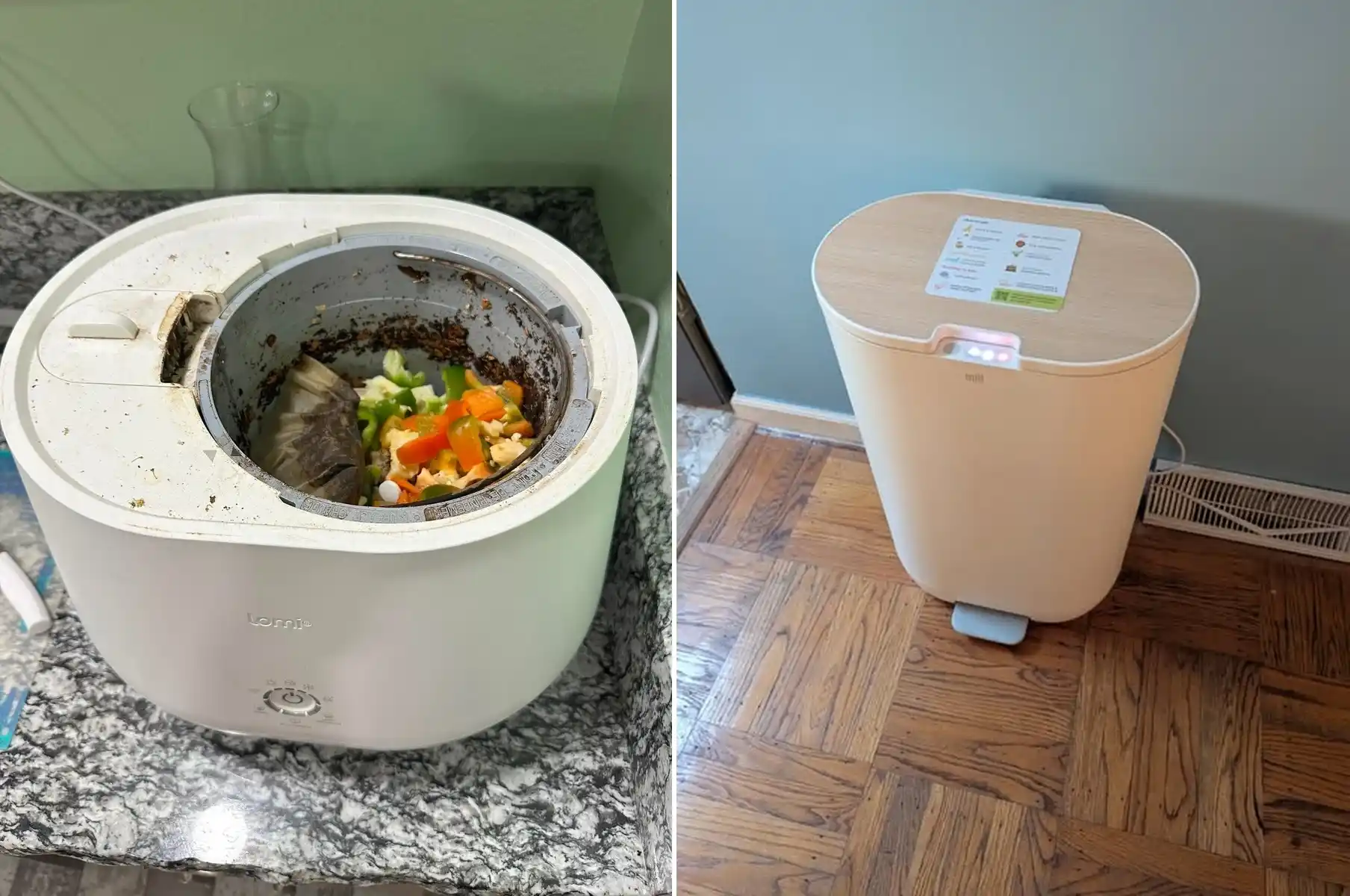
Mill vs Lomi subscription and filter costs: Lomi Bloom generally has lower recurring expenses when I use Eco-Express moderately and handle the processed scraps myself. Mill costs more upfront but offers a larger 6.5-liter bucket, longer intervals between emptying, and an optional $192 annual Food Grounds Pickup service. Once I include electricity, replacement filters, rental options, warranty protection, and maintenance, the cheaper machine depends on how often I use it and what I plan to do with the processed food scraps.
I wouldn’t make this decision based on replacement-filter prices alone. A $29.99 Lomi refill sounds inexpensive until I start replacing it every 45 cycles. Likewise, Mill’s $59 Essential filter doesn’t tell the whole story if I also need to pay $192 annually to send Food Grounds back through USPS.
For a meaningful comparison, I look at three things:
- What I pay to buy or rent the machine.
- What it costs to operate over one and three years.
- What happens when the machine needs maintenance, warranty service, or replacement parts.
Mill vs Lomi: Complete Annual Operating Cost Comparison
The first difference is how each manufacturer handles consumables.
Mill sells replacement filters for its Essential and Plus models. Lomi uses activated-carbon filtration compartments and sells replacement carbon in refill packages.
Here are the recurring expenses I would budget for.
Mill Essential and Mill Plus
Mill Essential
- Replacement carbon filter: approximately $59.
- Recommended replacement interval: 5–6 months.
- Annual filter budget: approximately $118–$142.
- Optional Food Grounds Pickup: $192/year.
- Electricity: approximately 0.7 kWh per day under Mill’s reported typical usage estimate.
Mill Plus
- Replacement carbon filter: approximately $114.
- Recommended replacement interval: 10–12 months.
- Annual filter budget: approximately $114.
- Optional Food Grounds Pickup: $192/year.
- Electricity: approximately 0.7 kWh per day under Mill’s reported typical usage estimate.
The difference between Essential and Plus is smaller than I initially expected when looking at annual filter expenses.
Essential requires more frequent replacements, but Plus doesn’t necessarily deliver a dramatic reduction in annual maintenance costs.
Lomi Bloom
Lomi uses two activated-carbon filtration compartments.
Its recommended replacement interval is every three months or 45 cycles, whichever comes first.
The replacement options include:
- One refill: approximately $29.99.
- Four refills: approximately $89.99.
- Annual filter budget at moderate usage: approximately $90–$112.50.
LomiPods are separate.
A 45-pack costs approximately $29.99, and the manufacturer recommends one tablet per cycle when making Lomi Earth for soil use.
If I mainly use Eco-Express, I don’t need to include LomiPods in my ordinary annual operating budget.
If I use Grow Mode regularly, however, those tablets become a meaningful recurring expense.
Food Grounds vs Finished Compost: Why Disposal Affects Ownership Cost
Mill does not produce finished compost. It dries and grinds food scraps into a material called Food Grounds, which still needs further decomposition before it can be treated as mature compost. If I cannot compost or dispose of that material locally, I may need Mill’s optional $192-per-year Food Grounds Pickup service.
Lomi’s output also depends on the processing mode. Eco-Express does not require LomiPods, but Grow Mode uses them to make Lomi Earth. At approximately $29.99 per 45-pack, regular Grow Mode use adds another recurring expense. The cheapest operating setup therefore depends partly on what I plan to do with the processed scraps.
The output’s texture, odor, and proper use in soil deserve a closer look. See our guide to Mill Food Grounds vs Finished Compost and our food recycler odor and maintenance guide for more detail.
Electricity Cost: The Expense Missing From Most Mill vs Lomi Comparisons
Electricity is easy to overlook because neither appliance looks particularly power-hungry.
But both machines use heat, airflow, and mechanical processing to reduce food waste.
I would include electricity in any serious ownership-cost calculation.
For this comparison, I use an illustrative US electricity rate of $0.16–$0.23 per kWh. Your actual utility rate may be higher or lower.
How Much Electricity Does Mill Use?
Mill estimates typical electricity consumption at approximately 0.7 kWh per day, averaged over multiple weeks of household usage.
That translates to:
- Monthly electricity consumption: approximately 21 kWh.
- Annual consumption: approximately 255.5 kWh.
- Annual electricity cost: approximately $40.88–$58.77.
At $0.178/kWh, the estimated monthly cost is approximately $3.74.
This is a useful number because it comes from Mill’s reported typical usage estimate rather than assuming the machine operates at maximum power continuously.
Mill’s processing cycles vary with the amount and moisture content of food scraps. It can skip cycles when there is little food waste to process.
How Much Electricity Does Lomi Bloom Use?
Lomi’s electricity consumption varies considerably by processing mode.
An independent Lomi Bloom watt-meter test reported approximately:
- Eco Mode: 0.64 kWh per cycle.
- Grow Mode: 0.93 kWh per cycle.
Using those measurements, here is what I would budget.
If I run Eco Mode 150 times per year:
- Electricity: 96 kWh.
- Annual cost: $15.36–$22.08.
If I run Grow Mode 150 times per year:
- Electricity: 139.5 kWh.
- Annual cost: $22.32–$32.09.
If I run Grow Mode every day:
- Electricity: approximately 339.45 kWh annually.
- Annual cost: approximately $54.31–$78.07.
The last scenario is particularly useful for understanding why usage frequency matters.
Running Grow Mode every day can add $50–$80 to the annual electricity bill, even before accounting for replacement carbon and LomiPods.
These are estimates based on independent cycle measurements, not guaranteed consumption figures for every Lomi Bloom.
Year 1 vs Year 3: Total Cost of Ownership (TCO)
This is the comparison I would look at before buying either machine.
The following table includes the purchase price, replacement filters, electricity, and optional Mill Pickup service.
For a consistent comparison, I use:
- Mill: 0.7 kWh/day.
- Lomi: 150–200 Eco cycles annually.
- Electricity: $0.16–$0.23/kWh.
- Mill Pickup: $192 annually when selected.
- LomiPods: excluded because the baseline assumes Eco-Express.
- Taxes, repairs, extended warranties, and resale value: excluded.
Year 1 and Year 3 TCO Comparison
| Cost category | Mill Essential | Mill Plus | Lomi Bloom |
|---|
These are modeled costs, not guaranteed bills. Filter replacement frequency and actual usage can change the results.
One important detail: Mill’s Pickup service is optional. I wouldn’t include it automatically in every Mill owner’s TCO.
What If I Use Lomi Grow Mode Instead?
The baseline above assumes Eco-Express.
If I run 150–200 Grow Mode cycles annually, I also need to budget for LomiPods.
At approximately $29.99 per 45-pack, purchasing four to five packs would cost approximately $120–$150 annually.
The additional electricity would be approximately $22–$43 annually.
That brings the estimated Lomi annual operating budget to approximately:
- Carbon filters: $90–$112.50.
- LomiPods: $120–$150.
- Electricity: $22–$43.
- Total: approximately $232–$306 per year.
That is a more realistic budget for someone who regularly uses Grow Mode.
Mill Rental vs Buying Outright: Is $35 per Month Worth It?
Another important part of the Mill subscription discussion is the rental model.
Mill has advertised rental promotions around $35 per month with a 12-month commitment.
That is different from buying a Mill Essential for $999 or a Mill Plus for $1,149.
A rental offer has included:
- The food recycler.
- Rental warranty coverage.
- Replacement charcoal filters when needed.
- A 30-day trial under the advertised promotion.
However, I would not assume that Food Grounds Pickup is included. Mill’s terms treat Pickup as a separate service that can be added to a rental account.
How Much Does Renting Cost?
At the advertised $35 monthly rate:
- One year: $420.
- Two years: $840.
- Three years: $1,260.
This is before any separately charged Pickup service or other applicable fees.
Compare that with the Essential purchase price of $999.
| Ownership period | Rent at $35/month | Buy Essential |
|---|
Buying outright becomes more attractive if I intend to keep the machine beyond approximately 28.5 months, assuming the rental price remains $35 and ignoring differences in included services.
But there is an important catch.
When I rent, I don’t own the appliance. If I cancel, I must return it. Mill’s terms also explain that an annual paid-monthly subscription has a 12-month commitment, and early cancellation can trigger charges for the remaining months.
I would read the checkout terms carefully before signing up.
My take: Renting makes more sense if I want to try Mill without committing nearly $1,000 upfront. Buying makes more sense if I already know I will use the machine for several years.
Warranty and Repair Costs After the First Year
A food recycler contains more than a simple heating element.
There are fans, sensors, motors, moving components, seals, and electrical controls. A failure in one of these areas can turn a relatively inexpensive maintenance item into a costly repair.
I would not ignore warranty coverage when comparing the two machines.
Mill Warranty
Mill’s consumer information states that purchases of Mill Essential and Mill Plus include a two-year limited warranty.
Mill also offers additional protection through its Extend Product Protection program, which can add two years of coverage.
For rental customers, Mill describes warranty coverage while the rental subscription remains active and paid.
This is an important advantage of renting if long-term repair coverage is a priority.
However, I wouldn’t assign a made-up dollar amount to a replacement motor or auger. Mill does not provide a universal public repair-price schedule for every possible mechanical failure.
Lomi Warranty and LomiCare
Lomi’s standard hardware warranty is one year.
Its LomiCare extended protection adds two more years, providing up to three years of total coverage.
The listed LomiCare price used in this comparison is $139.99.
That is approximately $140 upfront, not necessarily a $5–$9 monthly membership.
The extended warranty has conditions, including:
- Purchase within the required period.
- Proof of purchase from Lomi or an authorized retailer.
- Coverage limited to qualifying defects.
- Normal wear and tear is excluded.
- Shipping fees may apply in certain circumstances.
There is also an important distinction between a defective component and normal wear.
A scratched or worn ceramic-coated bucket is not automatically a warranty-covered failure.
Which Warranty Is Better?
Mill has an advantage on standard purchase coverage with its two-year warranty.
Lomi offers an additional two years through LomiCare, but its coverage costs extra.
If I were keeping either appliance for three years, I would compare the actual protection terms rather than assuming that a warranty covers every replacement part.
Bucket Wear and Replacement: An Overlooked Long-Term Expense
The processing bucket is one of the components I would pay attention to over time.
Both machines handle wet, sticky, and sometimes abrasive food scraps.
Lomi Bloom Bucket
Lomi uses an aluminum bucket with a ceramic-coated interior.
Sticky food residue can accumulate, particularly when processing sweet fruit scraps.
I would avoid aggressive scraping or abrasive cleaning pads because they can damage the coating.
Lomi provides a Cleaning Mode intended to loosen residue.
However, I could not establish a reliable manufacturer-confirmed replacement price or a guaranteed service life for the Bloom bucket.
I would therefore avoid adding an unsupported $60–$80 replacement expense to the TCO table.
If the coating becomes visibly damaged, I would contact Lomi before continuing to use the bucket.
Mill Bucket
Mill uses a larger removable bucket designed to handle repeated drying and grinding cycles.
Its construction is substantial, but that doesn’t mean it is immune to wear.
I would inspect:
- The bucket interior.
- The rotating components.
- Areas where food residue accumulates.
- Any unusual grinding sounds.
- Changes in how easily the bucket can be removed.
Mill does not publish a universal replacement cost for every bucket or mechanical component.
For this reason, I treat bucket replacement as a potential repair reserve rather than a confirmed annual consumables expense.
Cost Per Pound: Which Machine Is More Economical for Heavy Users?
This is where a simple annual filter-price comparison can become misleading.
A household processing 20 pounds of scraps weekly has a very different ownership profile from someone processing only a few pounds.
For a four-person household generating 15–20 pounds of food scraps per week, annual waste production would be:
- 15 lb/week: 780 lb/year.
- 20 lb/week: 1,040 lb/year.
However, I would not assume that both machines process that exact amount.
Mill’s 6.5-liter bucket and Lomi’s smaller processing bucket have different practical capacities. Wet food density also varies substantially.
A liter of vegetable scraps does not weigh the same as a liter of dense cooked leftovers.
Mill Cost Per Pound
Using the 780–1,040 lb annual household scenario, the Essential filter and electricity expenses total approximately $159–$201 per year.
That produces an illustrative operating cost of approximately:
- $0.15–$0.26 per pound without Pickup.
- $0.34–$0.50 per pound with Pickup.
This calculation excludes the initial machine purchase.
Lomi Cost Per Pound
For Lomi, using 150–200 Eco-Express cycles annually:
- Carbon refills: $90–$112.50.
- Electricity: $15–$29.
- Total: approximately $105–$142 annually.
If the machine actually processes the full 780–1,040 lb in that period, the illustrative operating cost would be approximately $0.10–$0.18 per pound.
But that throughput assumption must be verified by weighing the actual scraps processed.
I would not claim that Lomi can handle the same annual weight as Mill simply because both machines have a published bucket capacity.
Why This Calculation Matters
Mill provides energy-usage and processed-weight tracking through its app.
That makes it possible to calculate a more accurate operating cost:
Cost per pound = (annual filters + annual electricity + annual service fees) ÷ actual pounds processed.
For Lomi, I would use a kitchen scale and a simple cycle log.
That gives a much more defensible comparison than estimating pounds from bucket volume alone.
Resale Value: How Much Money Can You Recover?
Another expense many buyers overlook is depreciation.
If I buy a $999 Mill and sell it after two years, I don’t necessarily lose the entire purchase price.
The same applies to Lomi.
However, I would be cautious about claims that Lomi consistently retains 40–50% of its value after two years. There is no sufficiently reliable, representative dataset establishing that as a standard resale rate.
Lomi Bloom
Its smaller size makes it easier to package and transport than Mill.
Potential resale channels include:
- Facebook Marketplace.
- eBay.
- Local secondhand appliance groups.
I would expect condition, remaining warranty eligibility, included accessories, and proof of purchase to affect the price.
Mill
Mill is much heavier and bulkier.
That makes shipping less convenient, so local pickup may be the more practical resale option.
I would also consider the cost of packing and transportation before accepting an offer.
My recommendation: Don’t subtract an assumed resale value from the TCO unless you have actual sold-price evidence for the same model and condition.
DIY Cost-Saving Ideas: What Actually Makes Sense?
I understand why Mill and Lomi owners look for ways to reduce recurring expenses. But not every DIY shortcut is worth the risk.
For Mill owners, one of the biggest potential savings is avoiding the optional $192 annual Food Grounds Pickup service. For Lomi owners, buying replacement filters in multi-packs and using Eco-Express instead of Grow Mode can help control operating costs.
Lomi: Should You Use Generic Activated Carbon?
Some owners consider using aquarium carbon or bulk activated charcoal instead of Lomi’s official refill.
The important distinction is that activated carbon is not one universal material. Particle size, dust content, airflow resistance, and adsorption properties all matter.
I would not recommend simply buying generic carbon pellets and assuming they are equivalent to Lomi’s approved filter media. Even if the material looks similar, it may not have been tested for the machine’s airflow or filtration design.
The safer way to save money is to compare the cost per refill and consider purchasing a multi-pack rather than repeatedly buying individual refills.
Mill: Avoid the $192 Pickup Service
Mill’s Food Grounds Pickup service is optional. If I have a garden or access to a suitable local composting program, I may be able to avoid that annual expense.
However, Mill Food Grounds are dried and ground food scraps, not finished compost. Before choosing a disposal or composting option, I would contact the receiving site and confirm that it accepts this type of material.
Here are three alternatives worth checking.
1. MakeSoil: Find a Local Composting Host
MakeSoil connects people who have food scraps with local community members, called Soil Makers, who accept organic material for composting.
Its website provides a map for finding nearby Soil Sites, and its mobile app is available for users who want to arrange local drop-offs.
I would check the map before relying on this option. The number of active hosts varies by location, and not every Soil Maker necessarily accepts dried food scraps from a food recycler.
Website: https://www.makesoil.org/
2. Local Curbside Composting and Food-Scrap Drop-Off Programs
Many US municipalities and private composting companies operate residential food-scrap collection programs.
Depending on the area, these services may include:
- Weekly or biweekly curbside food-scrap collection.
- Community composting drop-off locations.
- Residential organic-waste subscriptions.
- Public collection bins at libraries, farmers’ markets, or community centers.
These programs are not available everywhere, and acceptance rules vary. Some collect raw food scraps but may not accept processed or dehydrated material.
Before putting Mill Food Grounds in a collection bin, I would check the local program’s accepted-material list or contact the operator directly.
For example, New York State provides an interactive map of food-scrap drop-off programs and residential collection services. Local residents can use it to find options in their area.
3. ShareWaste: Check Availability Before Depending on It
ShareWaste previously connected food-scrap donors with neighbors, community gardens, and composting hosts.
However, its availability has become less straightforward. Although its website and FAQ remain accessible, its Android app was removed from Google Play in December 2024. I would not present ShareWaste as a reliably available service without first confirming that its website, local listings, and contact functions work in the reader’s area.
If a local ShareWaste host is still active and agrees to accept Mill Food Grounds, it may remain an option. Otherwise, I would prioritize MakeSoil or an established municipal or private composting program.
My recommendation: Don’t automatically pay $192 per year for Mill Pickup if you have a practical local alternative. But don’t assume every composting host or municipal collection service accepts dried Food Grounds. Confirm acceptance before choosing a disposal method.
Which Machine Should You Choose Based on Your 3-Year Budget?
The three-year cost comparison makes the decision easier. Lomi Bloom has the lowest modeled ownership cost when I use Eco-Express and handle the output myself. Mill costs more upfront, especially if I add the optional Pickup service, but its rental option may appeal to buyers who prefer not to pay the full purchase price.
If Your 3-Year Budget Is Around $800–$1,000
Lomi Bloom is the more realistic choice.
Its modeled three-year cost is approximately $814–$1,024, depending on the purchase price, filter replacements, and electricity use. To stay near the lower end, I would use Eco-Express for most cycles and avoid unnecessary LomiPod purchases.
The main condition is that I need a practical way to handle the processed material without paying for an additional service.
If Your 3-Year Budget Is Around $1,500–$1,700
Mill Essential becomes an option if I can skip Pickup.
Its estimated three-year cost is approximately $1,476–$1,602, including the purchase price, filters, and electricity. Mill Plus costs approximately $1,614–$1,668 over the same period.
At this budget level, I would compare the additional features of Plus against the relatively small difference in annual filter expenses. I would not choose Plus simply because its filter lasts longer.
If Your 3-Year Budget Exceeds $2,000
Mill with Food Grounds Pickup may make sense if the collection service is important to me.
Adding the $192 annual service brings the modeled three-year cost to approximately:
- Mill Essential: $2,052–$2,178.
- Mill Plus: $2,190–$2,244.
This is the more convenient but more expensive ownership setup. I would choose it only if the collection service solves a real disposal problem that I cannot reasonably handle another way.
What If I Prefer Renting Instead of Buying?
At the previously advertised $35-per-month rental rate, three years would cost $1,260, before any separately charged Pickup service or other applicable fees.
That can reduce the upfront commitment, but I would compare the current rental terms, included services, and cancellation conditions before treating it as a cheaper long-term option.
My budget-based verdict: Lomi Bloom is the strongest choice for keeping three-year spending low. Mill Essential is worth considering when its larger processing capacity and ownership model justify the higher cost. Mill with Pickup is a convenience decision, not the lowest-cost option.
Final Verdict: Which Has the Lowest 3-Year Cost?
Lomi Bloom wins the lower-cost comparison when I use Eco-Express moderately and manage the finished material myself.
Mill Essential becomes more attractive when I produce larger amounts of food waste and can avoid the Pickup subscription.
Mill Plus is primarily a convenience upgrade rather than a major consumables-saving strategy.
My final recommendations:
- Lowest modeled 3-year ownership cost: Lomi Bloom with moderate Eco-Express use.
- Best for larger food-waste volumes: Mill Essential.
- Best for fewer filter replacements: Mill Plus.
- Best for buyers who prefer an appliance rental: Mill, if the current rental offer and commitment terms suit them.
- Best for households that want Food Grounds collected: Mill with Pickup.
The biggest lesson is that filter prices alone don’t determine ownership cost.
Electricity, processing frequency, warranty protection, disposal arrangements, and the amount of food waste actually handled all matter.
I also wouldn’t confuse dried Food Grounds with finished compost. Mill makes food scraps easier to store and transport, but further decomposition is still necessary before the material becomes mature compost.
If I were buying either machine today, I would calculate the cost per pound of food waste processed rather than simply choosing the machine with the cheapest replacement filter.
That is a much better measure of long-term value.